
Careful pruning that respects your trees and your property.
Tree pruning in Boucherville
Tree pruning in Boucherville helps property owners care for their trees and manage branches near buildings. ÉMONDEXPERT provides an experienced team and an approach tailored to your property.
Our company is a member of the Société internationale d’arboriculture (SIAQ) and the International Society of Arboriculture (ISA).
We have more than ten years of experience in the field and follow the safety measures recommended by the CNESST for tree pruning work at height.
Our certified arborists carry out work tailored to each tree and its surroundings.
Whether you have a mature tree near your home, branches extending over your roof or a tree that has become too dense, our team will assess the situation before deciding what work is needed.
Any questions? (450) 577-0220
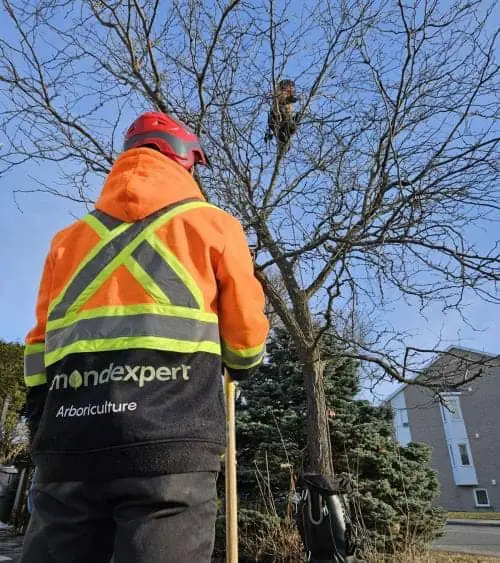
Tree pruning services in Boucherville
Our pruning services involve cutting selected branches to meet the tree’s needs and the owner’s objectives, while preserving as much of its natural structure as possible.
Unlike trimming carried out without an assessment, our professional pruning takes into account the tree’s species, age, structure and overall condition.
Our team does more than simply prune to reduce a tree’s size or improve its appearance.
Trees may be close to homes, garages, fences, power lines, parking lots and streets. When branches pose a safety risk or threaten the integrity of buildings, strategic pruning is needed.
Pruning can also help a young tree grow, thin out a mature tree to let in more sunlight, create an attractive shape or remove dead or damaged branches.
Careful planning
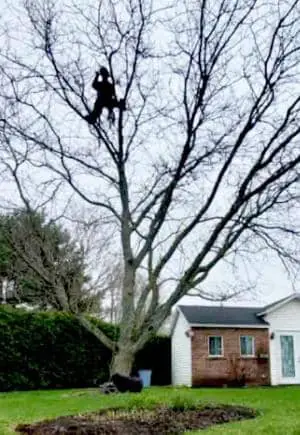
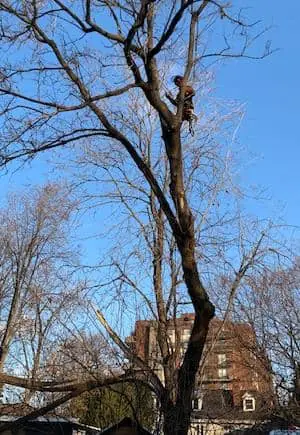
Our tree pruners must plan their work based on the space available around the tree, the direction in which the branches are growing and the risks involved (large, heavy branches falling).
Before starting work, our tree pruners examine the tree and its surroundings. This assessment helps determine which branches should be removed or retained, and whether another type of work would be more appropriate.
Every tree has its own characteristics and grows in a specific environment. In addition, a type of pruning that is appropriate for one species may not suit another. That is why our tree pruners tailor their approach to each tree.
Types of pruning
The work is determined by the needs identified on site. Several types of pruning may be considered:
Sanitation pruning
Sanitation pruning aims to remove branches that are dead, broken, diseased or at risk of falling.
We recommend this type of pruning after a storm with high winds, after a heavy snowfall or if you notice signs of decline.
Our inspection will determine which branches need to be removed and which can be left in place.
Maintenance pruning
Maintenance pruning makes it possible to monitor changes in the crown and correct certain problems over time.
The frequency of the work varies with the tree’s species, age, growth rate and surroundings. There is therefore no need to systematically prune every tree each year.
Regular monitoring can help identify branches growing close to a structure or showing signs of deterioration. This approach prevents certain problems from getting worse before they are addressed.
Structural pruning
On a young tree, cutting selected branches helps guide its growth and develop a stronger structure. The approach to structural pruning depends on the species and the tree’s natural shape.
Clearance pruning
Clearance pruning involves removing or shortening selected branches that are too close to a building, street, walkway or installation.
Pruning can also be useful when a tree grows near a driveway, parking lot or busy area.
Power lines require particular attention. Pruning work can be dangerous in these circumstances and must be entrusted to trained, certified and authorized tree pruners.
Never try to cut a branch yourself if it is touching a power line or could fall onto one.
Reduction pruning
When the size of a branch or a tree’s crown becomes a problem, reduction pruning may be considered. This requires carefully selecting the branches to remove while respecting the tree’s structure and its ability to continue growing.
Excessive reduction or poorly placed cuts can injure the tree and harm its growth and appearance.
Targeted tree pruning and severe cutting
The scale and placement of cuts matter more than the label used to describe the work. A selective approach aims to meet a clear objective while retaining useful, healthy branches.
Tree pruning involves targeted cuts to remove specific branches in order to improve the tree’s structure or protect buildings. The cuts must take the tree’s health and natural shape into account.
Severe cutting removes substantial parts of the crown and can change both the tree’s appearance and its response to future growth. It should not be treated as routine maintenance.
Severe cutting is not automatically the best solution when a tree takes up too much space or certain branches are dangerous. The choice of approach must reflect the tree’s condition, its location and the desired result.
Our tree pruner can explain the options and recommend the method best suited to the situation. Feel free to contact us for tree pruning in Boucherville.
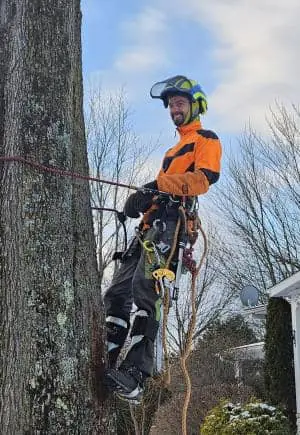
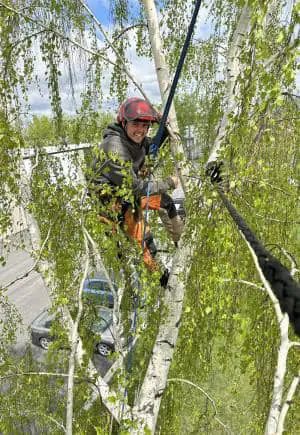
A qualified tree pruner for your trees
Quality pruning is best carried out with arboricultural knowledge, experience and a thorough understanding of the risks associated with working at height and handling branches.
A heavy branch can shift during cutting, catch on other branches or damage a structure if its descent is not controlled.
The ÉMONDEXPERT team has more than ten years of pruning experience and uses appropriate equipment.
Planning the work
Every project begins with an inspection of the tree and the site. Our team first considers access to the property, its layout, nearby buildings and obstacles.
We check for power lines, underground utilities and nearby pedestrian walkways. These factors influence the working methods and equipment we will use.
We assess the characteristics of the trees (height, trunk size, branch accessibility, dangerous branches, etc.).
Once the needs have been established with the owner, the work is planned to limit risks and protect the landscaping as much as possible.
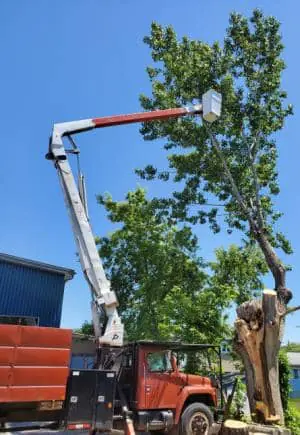
We also plan the measures needed to secure the danger zone and work area, then determine which equipment to use and divide the work among team members (on the ground, in the tree and in the aerial lift).
Pruning methods
Before starting, we check the tree’s health and look for fungi, cavities, root or structural defects, broken branches, ice and wet branches.
We plan the work in detail (why and how certain branches will be cut and which parts of the tree will be retained). The branches are then removed using a method suited to their size and location.
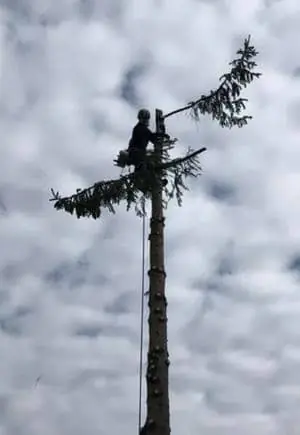
We select suitable anchor points, climbing methods and equipment before work begins. Climbing spikes are avoided on trees being retained to limit unnecessary bark injuries.
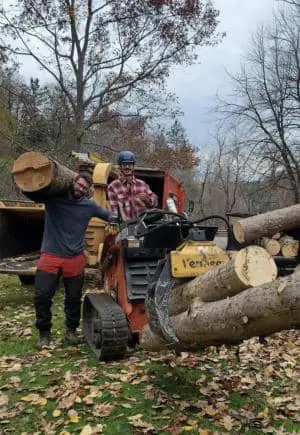
Once the cuts have been made, debris can be collected and branches chipped, as agreed with the client. When requesting a quote, it is best to specify whether you want the debris removed or would prefer to keep the wood chips for use in your yard.
Other ÉMONDEXPERT services
Pruning is not always the only work required. Depending on the tree’s condition and your objectives, other services may be needed:
tree pruning
We cut certain large branches when the situation requires it: risk of falling, clearance around power lines or infrastructure, a branch broken by the wind, a need for more sunlight, etc.
Tree cabling
To support certain weakened large branches, we can install support cables (strong cables designed for this purpose) when this solution is appropriate and helps preserve the tree.
Tree removal
Do you have one or more trees that need to be removed? Our team can remove the stumps too! We then chip the trunk and branches and leave your property clean.
Stump grinding
After removing a tree, we can grind the stump to make room for new landscaping. We can even lay sod or plant a new tree!
Tree planting
Our team plants trees using proper arboricultural techniques (including fertilization). We also plant cedar hedges and other types of hedges.
Hedge trimming
We maintain cedar hedges (and other types of hedges) to control their growth and keep them looking attractive. We also trim shrubs.
Examples of completed projects
Rue des Îles-Percées
A client in Boucherville needed a large dead tree removed because it was at risk of falling onto a building. Our team carefully planned the work.
We dismantled the tree in sections, making cuts at height using an aerial lift. The branches and trunk sections were lowered in a controlled manner to protect the nearby building.
Once the tree had been removed, our team ground the stump, chipped the branches and cleaned the property. Sod was laid over the former stump location.
Boulevard de Montarville
During a hedge trimming project, our team cut the branches to create a uniform height, reduce the width and give the hedges a neat shape.
Using high-performance equipment, our arborists precisely trimmed the sides and top of the hedge, rounding the top.
The trimmings were then collected to leave the property clean.
Planning tree care around your property
Agree on priorities before the work begins
Start by separating immediate concerns from improvements that can be planned for later. Identify broken branches, limbs rubbing against a roof and access routes that have become obstructed. Then describe what you want to retain: shade over a deck, privacy in the yard or the natural outline of a mature tree. Clear objectives help the arborist explain which cuts are useful and which healthy branches should remain.
Access matters as much as the height of the tree. Tell our team about narrow gates, pools, planted beds and busy parking areas. Agree on the spaces that need to be cleared before work starts and the arrangements for protecting the surrounding property. The quote should also clarify debris removal, branch chipping and whether any wood chips will be left for your use.
Observe the tree after pruning
Watch the tree from ground level and report a newly broken branch, a crack or an unexpected change in foliage. Avoid compacting the soil by parking vehicles or storing heavy materials around the trunk. Any follow-up should reflect the tree’s species, growth and condition. Another pruning visit is not automatically needed the following year. If branches are close to electrical infrastructure, stay clear and consult Hydro-Québec before considering further work.
Frequently asked questions about tree pruning
When is the right time to prune a tree?
Timing depends on the tree species, its condition and the reason for pruning. A broken branch that could fall needs prompt assessment, while structural pruning can usually be planned. Tell the arborist about recent storm damage, unusual leaf loss or construction near the roots. These details help establish priorities and choose a suitable approach rather than applying the same schedule to every tree.
How much foliage should be removed?
There is no single percentage that suits all trees. A young, vigorous tree and an older tree under stress have different tolerances. Removing too much live foliage can reduce the energy available for growth and trigger unwanted shoots. The proposed cuts should therefore have a clear purpose. Ask which branches will be retained, what clearance can reasonably be achieved and whether the work should be spread over more than one visit.
What information helps with a free quote?
Provide the property address, the number of trees and a description of the problem. Photos taken from a safe distance can show how branches relate to a roof, fence or driveway. Mention narrow access, parked vehicles and whether you want the wood chips kept or removed. An assessment is still needed to confirm the work method, the proposed cuts and the arrangements for protecting the site.
What should I watch for after the work?
Observe the tree from the ground and report new cracks, hanging branches or unexpected changes in foliage. Keep vehicles and stored materials away from the root zone where possible. Follow any specific aftercare advice given for your tree. A follow-up interval should reflect its species, condition and surroundings; annual pruning is not automatically required. If a branch is near a power line, stay clear and contact Hydro-Québec for guidance.
Request a free quote
Do your trees need maintenance pruning? Are branches getting a little too close to your home? Or does your hedge need trimming?
ÉMONDEXPERT takes care of it all!
To learn more about our services and tell us what you need, call us at (450) 577-0220.
Or get a quick, free quote for your tree pruning work in Boucherville or a nearby town.